
Begin with the object rather than the label
It is tempting to meet Garuda with a quick definition: a guardian, a bird, a sign of strength. Those descriptions can be useful starting points, but they are too small to explain the range of images that carry the name. Garuda appears across different periods, regions and religious settings. The most rewarding way to look is not to hunt for one universal message, but to ask what the maker has put in front of you: a body, a gesture, a companion, a setting and a use.
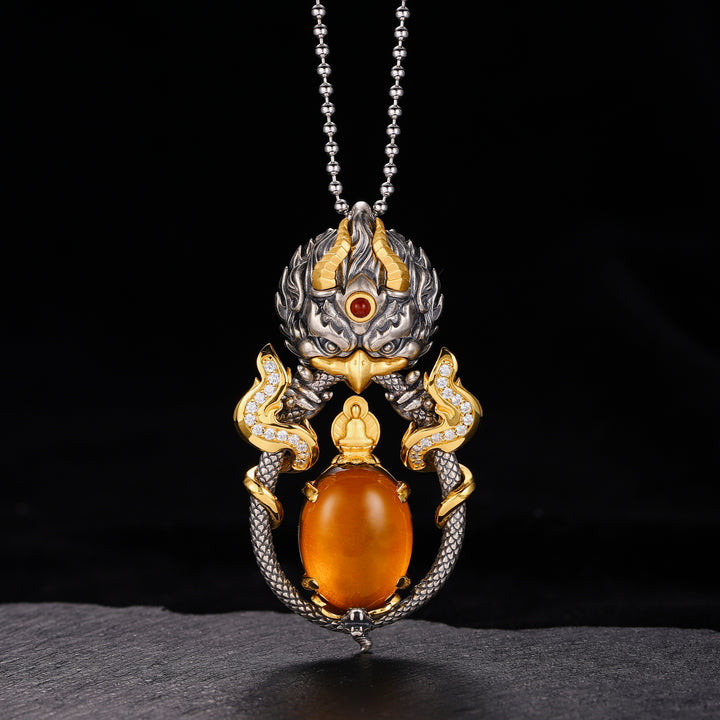
That approach also makes room for contemporary objects. A pendant may draw on a long visual vocabulary without claiming to reproduce a historical object. In Likreat's Guardians and Symbols collection, symbolic form is the invitation to look more closely, not a shortcut to a promised outcome.
1 The human bird form is not fixed
Garuda is often described as a human-bird being, but the balance between those two qualities can shift dramatically. A granite Garuda from Tamil Nadu in the Metropolitan Museum of Art is largely human in form, with wings as its clearest avian feature. The museum identifies it as Vishnu's mount and calls it a solar bird, while its relaxed seated posture makes the figure feel composed rather than airborne [1].
A late ninth-century Javanese bronze in the same collection takes another route. Its Garuda carries Krishna, has wings and a long openwork tail, and is part of a hanging oil lamp. The object was designed to cast shadows as it burned - a reminder that iconography is also shaped by material, movement and function [2]. The lesson is simple: wings alone do not settle the meaning of an image. Look at how the body moves, what it carries and what the object was made to do.
2 Read the relationship not only the pose
In many Hindu contexts, Garuda is understood in relation to Vishnu as a vahana, or divine vehicle. That relationship is visible in artworks where Garuda kneels in reverence, supports a divine figure, or appears ready for flight. A Pala-Sena sculpture in the Smithsonian's collection, for example, originally stood on a pillar facing a Vishnu temple. Its kneeling pose and serpent ornaments are not generic decoration; they belong to the object’s particular devotional setting [3].
This is why a close reading should begin with a practical question: who else is present? When Vishnu, Krishna, a temple setting or a specific gesture appears, the image gives the viewer a more precise context. When those elements are absent, it is better to describe the form you can see than to import an entire story into it.
3 Serpents carry narratives not automatic promises
Serpents recur in several Garuda stories and images. A British Museum record for a nineteenth-century Thanjavur painting describes Garuda returning with amrita and links the episode to a conflict involving serpents [4]. The Smithsonian sculpture shows serpents as ornaments in a different setting [3]. These examples tell us that serpents can be an important visual clue, but they do not license a single reading of every coiled creature on every Garuda object.
That distinction matters in jewellery. Curving forms may recall a narrative, balance a composition, or simply create visual tension. A responsible description can say what the design shows and point to relevant artistic traditions; it should not turn symbolism into a claim that the wearer will receive protection, luck or a guaranteed change in circumstance.
4 Place and function change the picture
A useful corrective to one-size-fits-all symbolism is to look at place. In a scholarly catalogue entry on a seventh-century terracotta Garuda from western Thailand, the Metropolitan Museum discusses the figure in relation to Vishnu, Buddhist dharma and regional ideas of royal authority. The point is not that every Garuda means all of those things. It is that the same figure can carry different work within a specific cultural and historical programme [5].
For a reader, that changes the question from 'What does Garuda mean?' to 'What is this image doing here?' A temple fitting, a lamp, a manuscript cover and a pendant belong to different visual worlds. Their forms may rhyme, but their purposes are not interchangeable.
A four step way to look at a Garuda object
• Name what is visible. Start with wings, beak, hands, posture, feathers, serpents or companions before assigning an interpretation.
• Find the relationship. Ask whether a deity, a narrative attribute or a devotional gesture gives the figure a specific role.
• Locate the object. Date, region, material and use can change the reading more than a generic label can.
• Separate inspiration from equivalence. A contemporary pendant can be informed by historical forms without becoming a historical artefact or carrying every meaning associated with Garuda.
Reading the Wrathful Garuda pendant
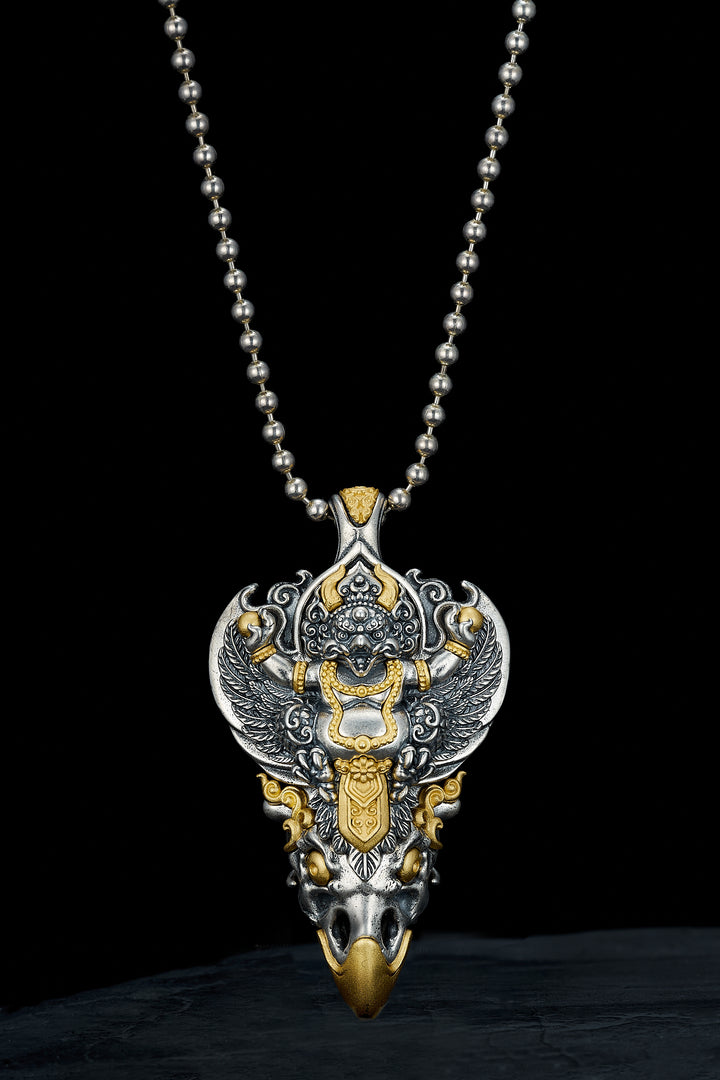
The supplied pendant rewards this slower kind of attention. Its sculpted wings create a broad silver-gray frame. Warm gold-toned dragons and accents move across that darker field, pulling the eye between raised arms, face, chest medallion and talons. The result is deliberately compact and high-relief: sharp feather geometry holds the silhouette together while the coiling forms keep it in motion.
Likreat's Wrathful Garuda Pendant Necklace describes a sterling-silver pendant with darker metal tones, warm gold-tone accents and hand-led shaping, assembly and finishing. Those stated material details are useful for reading this particular object. They do not need to become a claim that the pendant reproduces a single historical Garuda or delivers a spiritual result.
That restraint is part of what makes the design interesting. The pendant can be appreciated as a contemporary composition with an intense visual vocabulary: layered feathers, a powerful face, paired dragons and contrasting metal tones. The more specific our looking becomes, the less we need to reduce the object to a slogan.
Keep the question open
Garuda is most compelling when it is allowed to remain particular. A museum object may lead to a story about Vishnu, a temple, a court or a lamp. A contemporary pendant may lead first to carving, surface and silhouette. In both cases, the best reading starts with attention and ends with more context, not less.
To see how Likreat frames hand-shaped spiritual art jewellery across its collections, visit the Likreat brand story.
Sources
[1] The Metropolitan Museum of Art, Garuda (Vishnu's Mount) Seated in Royal Ease
[2] The Metropolitan Museum of Art, Krishna on Garuda
[3] Smithsonian National Museum of Asian Art, Garuda
[4] The British Museum, Garuda painting, museum number 1962 1231 0 13 25
[5] The Metropolitan Museum of Art, Lost Kingdoms Hindu Buddhist Sculpture of Early Southeast Asia