
The staff and the small object in the other hand are often the clearest clues in a Ksitigarbha statue. In many East Asian images, the staff belongs to the figure's monastic appearance, while the jewel expresses a devotional idea of aid or blessing. A crown, a seated pose, or an elaborate backdrop can change the first impression without making those attributes disappear.
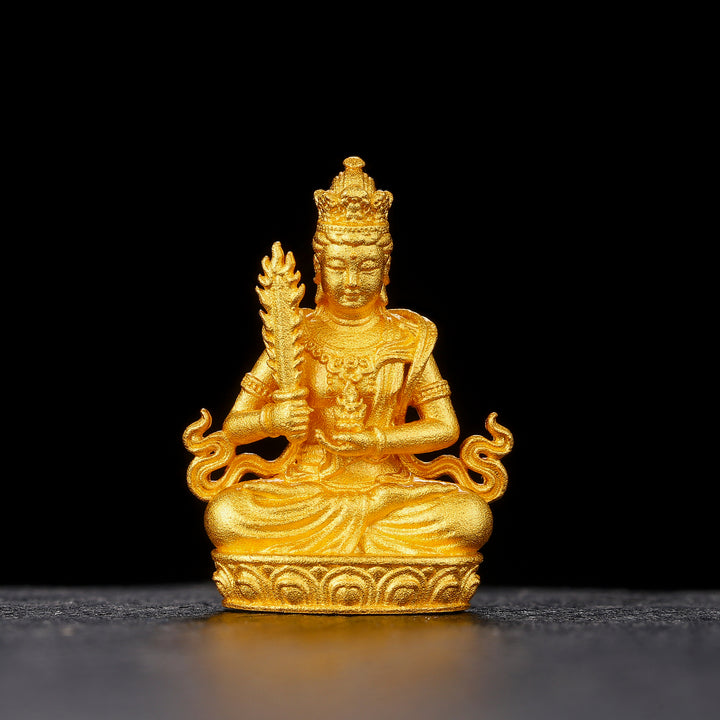
For Likreat's 地藏双层莲花摆件, sold as the Kṣitigarbha Double-Lotus Sculpture, those details are unusually easy to separate: a tall staff rises beside the head, a pale orb rests near the lap, and two bands of lotus petals form the base. Understanding their different roles makes the sculpture easier to appreciate without assigning a hidden meaning to every ornament.
Ksitigarbha Dizang and Jizo refer to the same bodhisattva
Museum titles use different names according to language and context. The University of Michigan Museum of Art identifies Ksitigarbha as Dizang in Chinese. The Metropolitan Museum of Art uses Jizo for a Japanese sculpture and Jijang for a Korean painting. These are names for the same bodhisattva, although the works need not look identical.[1][2][3]
In the Met's Japanese example, carved by Kaikei around 1202, Jizo wears a monk's robes and has a shaved head. The museum describes his religious role in relieving suffering in hell. Its Korean scroll, from the first half of the fourteenth century, also presents a monastic figure with a staff and jewel. A shared subject can therefore cross languages, media, and periods without requiring a single visual template.
The staff and its rings
Follow the shaft from the hand upward before looking at its decorative head. In the Kaikei sculpture, the Met calls this implement a shakujo and explains its shaking as an awakening from delusion. That is the museum's interpretation of a religious attribute, not a claim about what a modern sculpture will do for its owner.[2]
The rings deserve a closer look, but their number should not be guessed. Singapore's Buddha Tooth Relic Temple and Museum describes the six rings on its Memorial Hall statue as representing the six realms. On the same page, it describes a related prototype with a four-pronged staff and twelve rings.[4] Even within one institution's collection, the staff is not an unchanging diagram.
On the Likreat sculpture, loops hang from a tall, openwork staff head at the viewer's left. Some overlap in the photograph. It is possible to recognize a ringed staff without claiming an exact total or assigning each loop a meaning. A side view can help distinguish a hanging ring from the curved framework that supports it.
The jewel is an attribute rather than a material label
The Korean painting's catalog calls Ksitigarbha's jewel a cintamani, or wish-fulfilling jewel. Asia Society describes the jewel in its Japanese Jizo sculpture by Zen'en, dated around 1225–1226, as an emblem of wisdom within the deity's devotional imagery.[3][5] These names explain the represented object. They do not identify the substance from which a sculptor made it.
The pale sphere in the Likreat figure's left hand appears pearl-like. That visible resemblance is enough for a description; a photograph cannot establish whether it is a natural pearl, a cultured pearl, or another material. Likewise, the historical expression “wish-fulfilling” should remain a description of the religious symbol, not a promise attached to a purchase.
Sometimes the attribute has been lost. The Met says Kaikei's Jizo most likely once held a jewel in the left hand. That qualification matters: a documented identification can survive the loss of a small component. When comparing an unfamiliar statue with a museum image, an empty hand is a reason to read the catalog, not automatically to reject the comparison.
What a double lotus pedestal tells you
A lotus base connects the seated figure to a much wider Buddhist visual vocabulary. UMMA's Chinese terracotta plaque shows Dizang standing on a lotus amid flower tendrils in Amitabha's Western Paradise. Elsewhere, the Rubin Museum describes the lotus as a symbol of purity in its twelfth-century Lotus Mandala of Hevajra.[1][6] The flower occurs in different settings and is not an identifier unique to Ksitigarbha.
Here, “double lotus” also gives a straightforward instruction for looking. The Likreat base has an upper band of upright petals and a lower band turning downward. Their opposed directions broaden the support underneath the compact seated body. This is a visible construction of the design; the two tiers alone do not establish two spiritual realms or any other exact doctrinal pairing.
For a useful comparison, see the distinction between a flower held by a figure and the floral seat beneath it in our article on Green Tara's posture, hands and lotus. Similar flowers can play different roles within a sculpture.
The contemporary sculpture as a whole
The Kṣitigarbha Double-Lotus Sculpture adds a crown and flame-shaped surround to its seated figure. A circular row of clear accents frames the face; a red accent marks the front of the crown. The gold-tone finish links these parts visually, while the pale orb stands out against the folded robes.
The staff creates a long line beside the face, extending higher than the crown. The orb draws attention back down to the hand. Beneath both, the broad pedestal gives the figure a stable horizontal base. Seeing those relationships is more informative than treating the sculpture as a collection of unrelated symbols.
When comparing it with other works in Likreat's Sculpture collection, keep the entire outline visible, including the staff tip and the lowest petals. Use closer photographs to examine individual details afterward. The historical examples supply context for the subject; they do not establish this contemporary object's age, origin, consecration, or religious use.
Sources
[1] University of Michigan Museum of Art, Votive plaque depicting Ksitigarbha in Amitabha's Western Paradise, Chinese, 618–907, 1964/2.19.
[2] The Metropolitan Museum of Art, Kaikei, Jizo Bodhisattva of the Earth Store, Japan, ca. 1202, 2015.300.250a, b.
[3] The Metropolitan Museum of Art, Kshitigarbha, Korea, first half of the fourteenth century, 29.160.32.
[4] Buddha Tooth Relic Temple and Museum, Bodhisattva Kshitigarbha. Used for its descriptions of its own Memorial Hall statue and prototype.
[5] Asia Society, Zen'en, Bodhisattva Kshitigarbha, Japan, ca. 1225–1226, 1979.202a-e.
[6] Rubin Museum of Himalayan Art, Lotus Mandala of Hevajra, northeastern India, twelfth century, C2003.10.2. Sources accessed September 11–12, 2026.