
Mahasthamaprapta is easiest to understand not as an isolated symbol, but as part of a larger relationship with Amitabha and Avalokiteshvara in Buddhist art.
A figure that is often read in relation
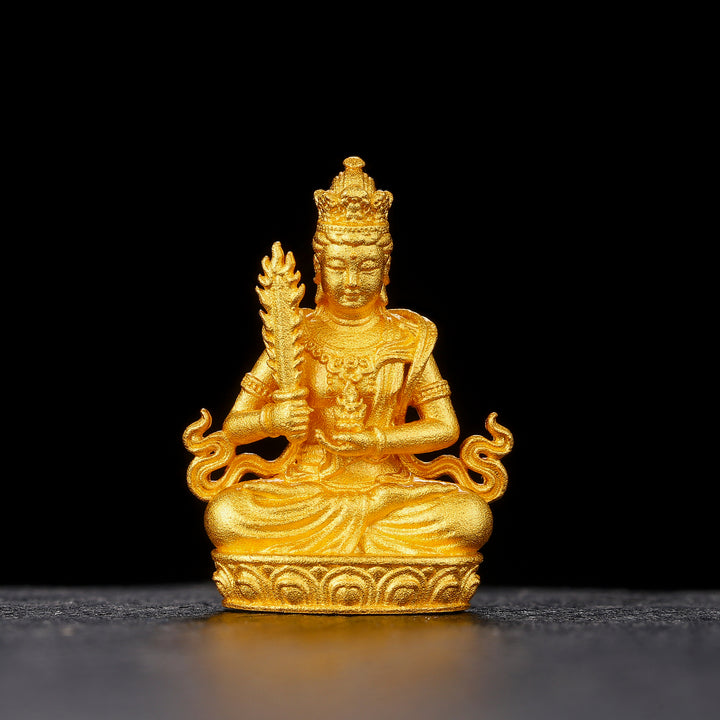
The supplied small figure is identified as Mahasthamaprapta, also rendered Dashizhi in Chinese. The most useful first fact is relational: Mahasthamaprapta is frequently encountered beside Amitabha and Avalokiteshvara rather than as an isolated protagonist. This changes the question from “what does this statue guarantee?” to “what larger visual relationship does this figure recall?”
The triad is an important clue
A seventh-century Chinese stele in the Metropolitan Museum of Art identifies Mahasthamaprapta through the vase on the headdress and explains that the bodhisattva is usually part of a triad with Avalokiteshvara and Amitabha. The museum's Qing painting of Mahasthamaprapta likewise describes a triptych arrangement with Avalokiteshvara and a central Amitabha. These records make context more valuable than a single generic pose.
A background story told through companions
The name Mahasthamaprapta is often rendered in Chinese as Dashizhi and translated as “one who has attained great power.” Yet the figure's historical story is frequently one of relationship rather than solitary action. In the Met's Qing painting, Mahasthamaprapta appears on a lion with a female attendant, a pearl, lotus stems, and a vajra-like implement; the record explains that the painting was likely designed to stand with Avalokiteshvara and a central Amitabha. The surrounding figures make the bodhisattva's role legible.
This is useful background for a compact modern figure. It explains why a visitor may find fuller accounts in triads, triptychs, or paintings than in a single tabletop object. It does not license us to transfer the lion, pearl, or exact hand gesture from a Qing painting onto this supplied figure when those details are not visibly present.
Why a small single figure still makes sense
A modern tabletop object does not need to include every member of a historical triad to evoke that tradition. A single figure can be a compact prompt to remember a larger composition. But it should not be treated as proof that the maker followed one canonical historical model, or that every crown, hand, or pedestal carries one fixed meaning across regions and periods.
Compare without flattening
Mahasthamaprapta, Avalokiteshvara, and Amitabha can appear in related settings, yet their visual identities are not interchangeable. When looking at a small object, compare the headpiece, the objects held, and the way an artist arranges the body. If an identifying detail cannot be seen clearly, retain the supplied product name and leave the uncertain feature undescribed.
The value of a relational reading
This approach makes a small golden figure more legible without overclaiming. Instead of isolating the image as a decorative symbol, it connects the object to the paired and triadic compositions documented in Buddhist art. That is a richer starting point for readers who want cultural context rather than a sales promise.