
A sword is the most dramatic object in many images of Manjushri, but it is not always the best place to begin. The blade may be small, partly hidden, or entirely lost. A book may sit on a flower rather than in a hand. In another work, a rosary joins the group of attributes. Museums identify these figures by reading the parts together: hands, stems, supports, surviving fragments, and the arrangement around the body.
That makes Manjushri a useful case study in careful looking. The sword, book, and lotus are not a code in which every object has one fixed position. They form a visual relationship that changes across region, date, medium, and specific form. The method below uses documented museum objects to show what can be said with confidence - and where a photograph should leave us uncertain.
Start with the book and ask where it rests
In a twelfth-century Tibetan sculpture at The Metropolitan Museum of Art, a palm-leaf manuscript, or pustaka, appears on a lotus bloom. The museum treats that manuscript as a principal identifier of Manjushri and connects it with awakened knowledge.[1] The hand does not have to grip the book for the attribute to belong to the figure. Follow the flower stem from the hand or elbow toward the shoulder, then inspect what the bloom supports.
A Ming-period Chinese hanging scroll at the Cleveland Museum of Art makes the same visual point in a different medium. The museum identifies the book on a lotus by the figure's left shoulder as the clue to Manjushri.[2] This is especially helpful when a painting is crowded or when another expected attribute is not prominent. Position matters, but relationship matters more: figure, stem, bloom, and book belong to one connected arrangement.
Read the sword as an attribute not a weapon scene
The Met's Tibetan sculpture pairs the manuscript with a sword. Its catalog explains the sword as cutting away impediments to enlightenment. That wording describes the religious imagery of the museum object; it is not a claim that a modern object will produce a result for its owner.
The same sculpture also shows why condition matters. The blade is missing, but the hilt remains in the projecting hand.[1] If you looked only for a complete sword, you might miss the identification. First trace the raised arm and hand. Then look for a grip, guard, or broken attachment point before deciding that the attribute is absent.
A standing Manjusri from twelfth- to thirteenth-century India at the Cleveland Museum of Art offers a more complete comparison. The right hand raises a sword above the crown, while the left holds a winding lotus stem that supports a small book.[3] Here the two attributes create an easy diagonal across the figure. Other objects compress that arrangement or place both items closer to the shoulders.
The lotus may be a seat a stem or an attribute support
Lotuses can occupy several roles in Buddhist art. A figure may stand or sit on a lotus base; a hand may hold a lotus stem; a flower beside the shoulder may carry another object. These roles should not be merged. A lotus under the body supports the figure. A lotus carrying a book helps present an identifying attribute.
A large seventeenth- to eighteenth-century Chinese silk applique at the Met places Manjushri's sword and book on adjacent lotuses and shows him riding a blue lion.[4] The sword and book remain identifying objects even though the hands do not present them in the same way as the standing Indian bronze. Compare this with our guide to Green Tara's posture, hands and lotus, where the flower, gesture, and extended leg work together differently. A lotus alone does not identify either figure.
Allow for variation and lost parts
A ninth-century Kashmiri Manjushri on loan to the Met broadens the comparison. Its catalog lists a wisdom book, blue lotus, and rosary among the handheld identifiers. A fourth attribute is lost; the museum cautiously proposes either another blue lotus or a sword.[5] That uncertainty is useful. It shows how a careful catalog distinguishes what survives from what is reconstructed.
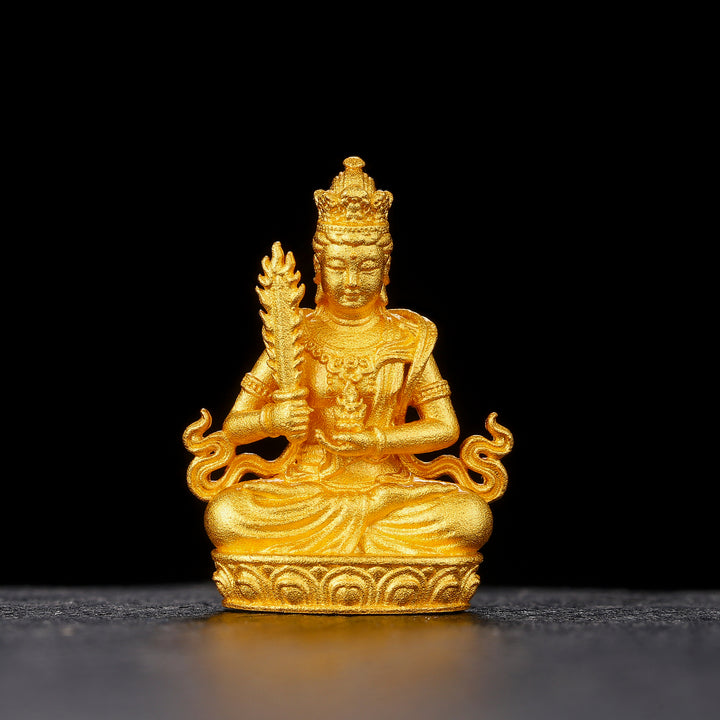
When looking at a small sculpture or jewelry photograph, use the same discipline. Name the visible object first. If a form is too small to distinguish as a manuscript, flower, or loop of beads, do not force the label. Consult the product title or a museum record, but keep the record's certainty separate from your own view of the photograph.
A four step method for reading the whole figure
- Trace the hands. Locate each hand and follow the direction of the fingers, grip, or raised arm. This can reveal a surviving hilt even when the blade is gone.
- Follow every stem. A thin line leaving a hand may rise to a blossom beside the shoulder. Check whether the flower supports a book, sword, or nothing visible.
- Separate attributes from supports. Distinguish the lotus seat beneath the body from a handheld lotus and from the object placed on its bloom.
- Compare the ensemble. Use the sword, book, lotus, posture, and catalog identification together. One isolated object is rarely enough for an unfamiliar figure.
This method does not replace specialist iconographic study. It gives a direct visitor a reliable first pass and a clear way to record uncertainty.
Reading the 七彩玲珑球 Manjushri orb locket
Likreat's Manjushri Multicolor Orb Locket Pendant, internally named 七彩玲珑球, separates exterior and interior into two viewing stages. The main photograph shows the closed rounded shell, patterned in green, blue, red, rose, and warm gold tones beneath a small bead and brown braided cord. An open product photograph reveals a seated figure inside the hinged orb.
In that open view, the figure raises a curved blade in its right hand. The remaining details are much smaller. The photograph does not give a clear enough view to verify a manuscript, so this article does not claim one is present. That limit is part of responsible looking: the product title identifies Manjushri, the sword is visible, and finer attributes should wait for a sharper angle.
The locket's open-and-closed sequence also changes how the image is read. The patterned sphere is the first object the viewer encounters; the figure and raised sword appear only after the shell opens. Browse the Buddhist Tradition collection to compare how other contemporary designs make a figure, inscription, or symbolic form visible. In every case, museum examples provide historical context, not proof of a modern object's age, consecration, ritual status, or spiritual effect.
Sources
[1] The Metropolitan Museum of Art, Manjushri the Bodhisattva of Transcendent Wisdom, Tibet, 12th century, 1983.554.2.
[2] Cleveland Museum of Art, Manjushri, China, Ming dynasty, c. 1500-1550, 1989.67.
[3] Cleveland Museum of Art, Standing Manjusri Arapacana Form, India, Pala period, 12th-13th century, 1985.189.
[4] The Metropolitan Museum of Art, Manjushri the Bodhisattva of Transcendent Wisdom, China, 17th-18th century, 15.95.154.
[5] The Metropolitan Museum of Art, Manjushri the Bodhisattva of Transcendent Wisdom, Kashmir, 9th century, L.2017.31.2. Sources accessed September 14, 2026.