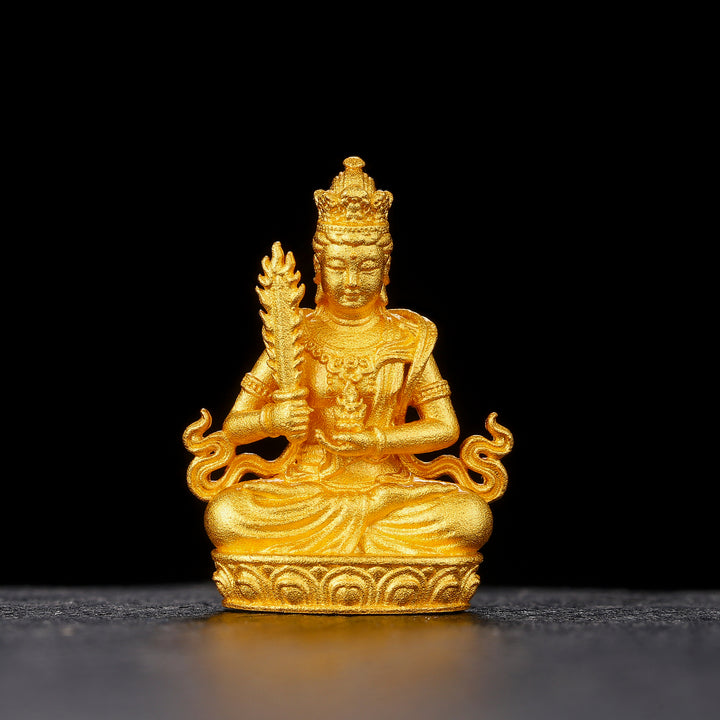

Medicine Buddha imagery is widely associated with Bhaishajyaguru, also known in East Asia as Yakushi or Yaoshi fo. This guide offers a way to look closely at one contemporary Tibetan-style seated figure. It is not an authentication, a material assessment, or a statement about ritual status.
Start with the name, then leave room for variation
“Medicine Buddha” is a useful English label for Bhaishajyaguru, a Buddhist figure associated especially with medicine in museum terminology. Yet the appearance of Medicine Buddha images changes across regions, periods, and workshops. A sculpture in the collection of the National Museum of Asian Art, for example, sits in a crossed-leg posture on a double-lotus throne, while a Japanese Medicine Master Buddha at The Met is identified in part by a small medicine jar and a raised hand.
That variety matters. It is better to treat the supplied figure as a Tibetan-style interpretation than to assume that every feature repeats one historical model exactly.
Read the whole silhouette before naming small details
This figure is arranged as a compact vertical composition: a high crown leads into a calm face, a broad upper body, a crossed-leg seat, and a layered pedestal. The overall outline is symmetrical even though the small surface details are busy. Looking at this silhouette first helps distinguish the central figure from its surrounding ornaments.
The crown and jewelry-like surface treatment give the piece an ornate, Himalayan-style visual language. They should not by themselves be used to date the object, identify its workshop, or infer its material. They simply tell the viewer that the maker chose a richly decorated presentation rather than a plain monastic one.
Use the hand area carefully
Hands and held objects are often important in Buddhist iconography, but they are also the easiest details to overread in a small product photograph. Here, the hands sit close to the torso and lap. The forms are visible, but the image is not clear enough to claim a specific ritual gesture or object with confidence.
A useful comparison is the Met’s Yakushi painting, where the museum can document a medicine jar and a raised hand as identifiers for that particular work. The lesson is not that every Medicine Buddha figure must display those same signs. Instead, compare a feature only when the individual image makes it legible.
Notice the front animal form and the layered throne
At the front of this figure, an animal-like guardian form creates a strong foreground accent. Its exact identification should be left open unless supported by a maker’s description or specialist documentation. Visually, it draws the eye from the lap down toward the base and gives the sculpture a more animated profile.
The tiered pedestal does equally important work. Its repeated bead-like and petal-like bands separate the sacred figure from the ground line, echoing the throne structures found in many Buddhist images. The Smithsonian’s Medicine Buddha sculpture similarly uses a multi-level base and lotus throne, while a Yuan-period Medicine Buddha mural at The Met places the central Buddha in a much larger assembled setting. These are related visual languages, not proof that this contemporary figure copies either work.
What the gold finish can—and cannot—tell you
The warm gold-colored finish makes surface modeling easy to see: the crown, jewelry, robe folds, animal form, and base catch light at different depths. It does not establish the figure’s metal content, age, origin, or religious use. For a product image, color is best treated as a visible design choice unless product specifications state otherwise.
A respectful way to look longer
- View the whole seated figure before focusing on one symbol.
- Separate what is plainly visible from what needs documentation.
- Compare only with clearly credited museum works.
- Keep regional and historical differences in view.
For related examples, see our guides to the Ksitigarbha and Diting figure and the Mahakala figure. Each uses the same basic method: start with what the image shows, then avoid turning a visual cue into an unsupported claim.