
ARTICLE COPY
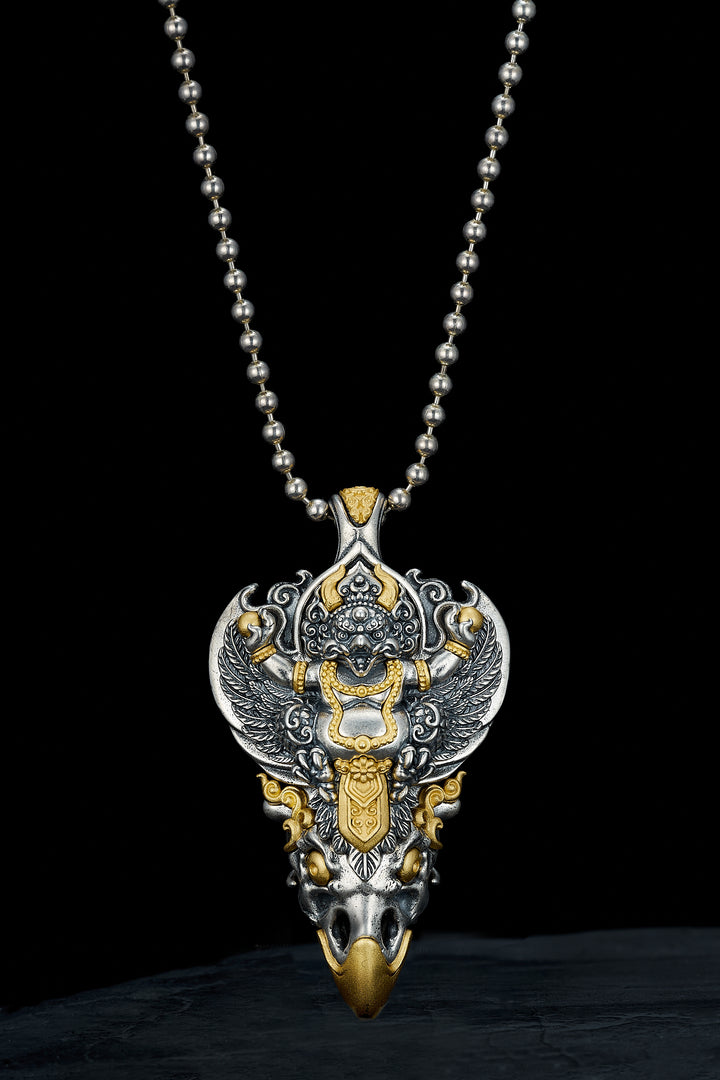
A pendant can ask to be read before it asks to be named. On the Garuda with Twin Dragon Maidens Pendant Necklace, the first impression is not a single figure but a held composition: wings press outward, the centre rises beneath the bail, and two smaller gold-tone figures anchor the lower edge. The result feels ceremonial because the eye is given a route through it. Start at the centre, travel along the wings, then return through the paired forms below.
That route is more useful than a quick symbolic answer. This is a contemporary piece, not a historical object to be decoded with false certainty. Yet its details belong to a visual field in which Garuda, wings, serpents, and symmetry have been interpreted in many different ways across regions and periods. Looking closely lets the pendant stay specific while keeping that larger history in view.
First, read the silhouette
The pendant works at distance because its silhouette is unusually legible. A compact head and high bail make a vertical spine. From that spine, layered feathers widen into two wings that almost form a shallow arch. The lower figures gather the composition back inward, keeping the piece from dissolving into a purely horizontal spread.
This balance of expansion and return is why symmetry matters here. The wings carry scale, while the paired figures make the lower half feel intentional rather than decorative filler. The product page describes spread wings, layered featherwork, ornamental relief, and a detailed bail. Those are practical cues for looking: notice where texture is repeated, where the warm gold-tone elements interrupt the darker metal, and how the eye alternates between the two sides.
Garuda is not one fixed body
It is tempting to reduce Garuda to “a giant bird.” Art history gives a more precise warning against that shortcut. A late eighth- or early ninth-century Garuda in the Metropolitan Museum of Art is predominantly human in form, with wings as its principal bird-like feature. That one object does not define every Garuda image, but it demonstrates how much the figure can change while wings continue to carry recognition.[1]
For this pendant, that variability is a useful lens. The figure at the centre is best read through its compositional role first: it is the hinge between the pendant’s upward pull and its lateral spread. Its wings are not an accessory. They are the device that turns a cluster of relief details into a single, readable form. Readers who would like a broader introduction can continue with Likreat’s earlier journal piece, Garuda in Art: How to Read Wings, Serpents and Devotion.
Bird and serpent in one field
Bird and serpent imagery has met in many artistic traditions, but the meaning is not stable from one place to another. A Met publication describes a Gandharan group in which Garuda vanquishes a naga clan, and presents the relationship as an antagonism between bird and serpent.[2] In a different, Cham architectural context, the Asian Art Museum notes that Garuda and serpent figures are often shown together, while serpent imagery carries local protective associations.[3]
Those records offer context, not a ready-made legend for this necklace. The paired lower forms on the pendant are sold as “Twin Dragon Maidens,” and the product’s name is the most appropriate way to identify them here. They should not automatically be called nagas, assigned to a single region, or treated as replicas of a specific historic sculpture. Their visual force lies in their doubling: they echo the two wings, add a second scale of detail, and make the central figure feel framed rather than isolated.
What the paired figures change
Without the two lower figures, the pendant would read as a dramatic single emblem. With them, it becomes a conversation of three centres. The eye moves from the central body to one figure, crosses through the feathered base, and returns to the other. Their warmer finish helps that movement. On a dark metal ground, the gold-tone passages act as small points of arrival.
This is also where close looking is more honest than broad claims. “Dragon Maidens” is the design name used by the store; it is not presented here as a verified historical classification. The phrase sets an imaginative frame, while the physical object supplies the evidence: mirrored placement, slender curling shapes, raised relief, and a shared footing beneath the wings.
A contemporary object, not a reconstruction
Likreat groups related works in its Guardians & Symbols collection. That is a helpful contemporary category: it tells a shopper what kind of visual language the object belongs to without asking it to stand in for a museum artefact. The pendant can draw on a wide field of guardian, bird, serpent, and ornamental imagery while remaining a newly made composition.
That distinction matters. Historical images are shaped by particular materials, rituals, patrons, places, and periods. A modern pendant has a different job. It has to hold together at necklace scale, work from a distance, reward a close look, and make a coherent object from several visual languages. Its success is not that it proves a single ancient source. It is that it stages an encounter between wings, paired figures, and relief in a form that remains readable on the body.
Five questions to bring to the piece
• Where is the strongest force placed: at the centre, in the wings, or at the lower pair?
• What becomes visible only when you compare the left and right sides?
• How do the gold-tone details change the rhythm of the darker metal?
• Which contours still read clearly when the pendant is seen from a distance?
• What remains deliberately unspecified, and why is it better not to force one story onto it?
A good piece of jewellery can keep offering new routes through itself. Here, the first route is structural: wings, spine, pair, return. The second is historical, but deliberately open-ended. Garuda and serpent imagery carry different histories across time and place; the pendant does not need to collapse those histories into a single claim to make them worth noticing.
For the wider context behind Likreat’s approach to objects and craft, visit the Brand Story. Then return to the pendant and look once more at its silhouette. The more precise question is not “what does it guarantee?” but “how has it been made to hold your attention?”
Source notes
[1] The Metropolitan Museum of Art, Garuda (Vishnu’s Mount) Seated in Royal Ease. Collection record, accessed 9 September 2026.
[2] The Metropolitan Museum of Art, Notable Acquisitions 1980–1981. Discussion of “Garuda Vanquishing the Naga Clan,” accessed 9 September 2026.
[3] Asian Art Museum, Architectural element with three-headed mythical serpent. Collection record, accessed 9 September 2026.