
A figure seated above a tiger, holding a raised weapon and a gold-colored object, can seem easy to identify. But a careful reading starts by treating those details as a group rather than as decorative shorthand. Museum records for Zhao Gongming show a tiger, a weapon, and a gold ingot appearing together in more than one arrangement. They also show why a contemporary sculpture should be described from what is visible and from its own product record—not treated as a historical object by default.
This guide uses that distinction to look at Likreat's Zhao Gongming Tiger-Rider Sculpture. The aim is not to promise wealth, protection, or ritual power. It is to make the visual evidence easier to read and the limits of that evidence clear.
Start with the tiger, but do not stop there
In an early twentieth-century Chinese New Year print at The Metropolitan Museum of Art, the museum identifies the tiger as the mount of Zhao Gongming, the God of Wealth. The same record names a gold ingot in one hand and a gnarled cudgel in the other. [1] That combination is useful because the tiger is not presented as an isolated animal motif. It works with the object in the figure's hands.
A tiger-like mount in a photograph is therefore a good place to begin, not a conclusion by itself. Animal supports can be stylized, cropped, or borrowed across designs. The stronger question is whether the mount is accompanied by other documented elements that belong to the same figure in a named source.
Read the weapon with the source beside you
The weapon can look different from one image to another. The Met uses the term “gnarled cudgel” for its print. The University of Michigan Museum of Art describes Zhao Gongming as well known for an iron club, while the figure in that woodblock print holds a staff. [2] The variation is a reason to avoid identifying every raised straight form in a product photo with an exact historical name.
A National Museum of Taiwan History record gives a more specific object context. It catalogues a wooden ritual implement as Zhao Gongming's iron whip and describes a Zhao image with a whip in one hand, an ingot in the other, and a black tiger below. [3] That record documents its own object and its associated sculpture; it does not certify the material or function of a contemporary accessory or statue.
For a viewer, the practical rule is simple: describe the form you can see first—raised, slender, club-like, or whip-like—then use the product title or a collection record only for what it actually identifies. This keeps a visual observation from turning into an unsupported attribution.
An ingot is more specific than any gold detail
Gold color appears in many decorative settings, so color alone does not identify an ingot. In the Met's print, the record explicitly calls the object a gold ingot and explains it as a symbol of wealth. [1] UMMA's description similarly places a gold ingot on the table in its print, while the tiger is beneath the table. [2]
These two works make an important point: the relationship among tiger, weapon, and ingot can remain recognizable even when the composition changes. One record shows a rider; the other places the tiger and ingot at different levels around a table. Reading the ensemble is more reliable than requiring a single pose.
Looking closely at the Likreat sculpture
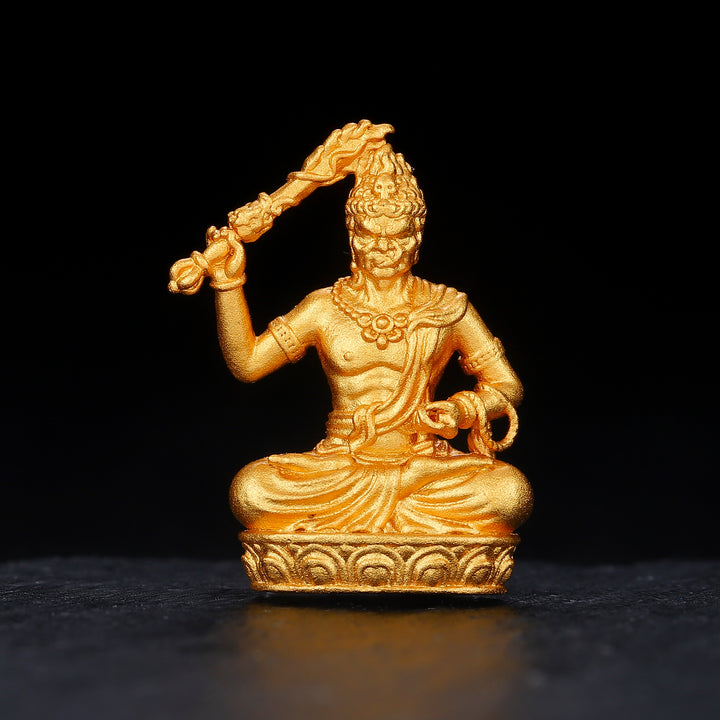
The active product is titled Zhao Gongming Tiger-Rider Sculpture. In the user-supplied product image, a gold-tone seated figure rises above a dark tiger-like mount. A raised weapon-like form establishes a strong upward diagonal, while the animal's body spreads low across the base. These are visible design features; the photograph does not establish the sculpture's age, material assay, ritual use, or relation to one particular historic work.
Likreat's product description calls out the dark tiger, a raised ceremonial weapon, and an ingot-shaped element. That naming makes the product's intended visual references easier to locate, but it should stay separate from the museum records. The first-party description is evidence for this contemporary product; the collection records are evidence for their distinct prints and ritual implement.
The arrangement is easy to follow if you look in three passes. First, trace the dark mount from head to base. Second, follow the raised line of the weapon back to the seated figure. Third, look for the small ingot-shaped accent only after the first two elements are clear. This sequence separates silhouette, gesture, and smaller detail instead of asking one bright surface to carry the whole identification.
Keep neighboring traditions distinct
Wealth-associated figures are not interchangeable. Zhao Gongming's documented tiger, weapon, and ingot differ from the mongoose and fruit discussed in our Yellow Jambhala guide. Those are different figures in different religious and artistic contexts. Similar subject matter is not a reason to merge their attributes, names, or practices.
If you are comparing related contemporary motifs, Likreat's Guardians and Symbols collection offers a useful next step. Apply the same method each time: note what is visible, compare it with a named record, and leave any unverified material, age, ritual, or promised outcome outside the description.
A source-aware way to look
Zhao Gongming imagery can be visually direct without being simple. A tiger, a raised implement, and an ingot may point the eye toward a well-documented identification, but each museum record still belongs to a particular time, medium, and composition. A contemporary sculpture can reference that vocabulary without becoming the historical object it resembles.
That boundary makes the work more interesting, not less. It lets the viewer notice how a present-day design organizes an old visual language while keeping the source, the product, and personal belief in their proper places.
Sources
[1] The Metropolitan Museum of Art, New Year's picture: God of Wealth riding on a tiger.
[2] University of Michigan Museum of Art, A Military God of Wealth, Marshal Zhao, Xuantan.
[3] National Museum of Taiwan History, Zhao Gongming's ritual iron whip.