
An Acala figure may look forceful at first glance, but its name points toward immovability. That tension between movement and steadiness makes the image particularly rewarding to study.
Start with the tension in the name
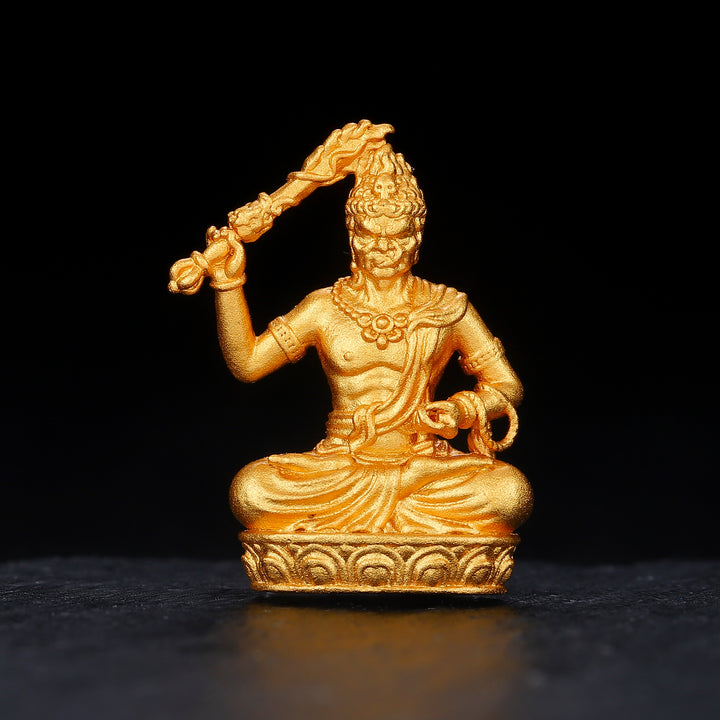
Acala is often encountered through the Japanese name Fudo Myoo, commonly translated as the Immovable Wisdom King. The supplied figure uses a forceful raised sword and a stern face, yet the name points to steadiness rather than motion. That tension is the best entry into the image. It helps explain why a compact object can feel energetic without being a scene of combat.
Sword, rope, and flame are a vocabulary
The Metropolitan Museum of Art describes a Japanese Fudo sculpture holding a sword and a lasso, and a later painting places the figure amid flames with the same implements. These are useful art-historical reference points. They do not prove that every modern object uses each feature in the same way, but they explain why viewers often look first for the raised blade, binding cord, or flame-shaped surround.
Wrathful does not mean careless
A wrathful expression is a deliberate artistic mode, not a cue to make claims about aggression or supernatural results. The Met describes Fudo as a direct emanation of Dainichi in Japanese Esoteric Buddhist contexts. That relationship gives the figure a place in a broader religious and artistic system, while the exact design of this small gold-colored object remains contemporary and should be described as such.
The figure's background is a scene of steadfastness
Acala is known in Japan as Fudo Myoo, the Immovable Wisdom King. In a thirteenth-century Japanese painting at The Met, Fudo stands in flames with a sword and lasso and is shown with the attendants Seitaka and Kongara. The record describes Fudo as a wrathful avatar of Dainichi, the cosmic Buddha. The visual force is therefore part of a carefully structured religious image: the blade, rope, flame, stance, and attendants all make the central figure's stillness feel active rather than passive.
This background helps explain why later images can look intense without being simple tales of battle. It is also a useful check on over-reading a compact object. The supplied seated figure refers to the same broad vocabulary, but it is not the historical painting, does not show every attendant, and should not be described as if it carries the exact ritual status or historical setting of a museum work.
How to inspect a compact Acala figure
Follow the silhouette from the raised sword down through the head, torso, and crossed legs. Then look for the contrast between sharp diagonals above and a stable seated base below. The supplied object is especially effective at this contrast: the sword creates upward movement while the lotus pedestal anchors the composition. This is a visual observation, not a claim about the item's ritual status.
Keep the interpretation proportional
A small Acala image can introduce readers to an important artistic vocabulary of stillness, flame, sword, and restraint. It should not be marketed as a guarantee of protection, courage, or a particular outcome. The more respectful reading is to recognize both the tradition that informs the figure and the limits of what a product photograph can establish.