
What turns a pendant into a small place to look, rather than simply a small image to wear? The supplied Dainichi Nyorai ghau box pendant offers a useful answer. Its design asks the eye to move in layers: from the ball chain and lotus-shaped bail, through the green and clear stone border, toward the seated figure in the center, and finally down to the small lower loop. Read in that order, the pendant becomes less like a flat emblem and more like a deliberately framed composition.
The supplied name identifies this contemporary piece as Dainichi Nyorai and a ghau box. The photograph can show its visible construction, color relationships, and image layout. It cannot by itself establish metal composition, the identity of every stone, a historical date, a consecration, contents behind the central figure, or any spiritual outcome. Those distinctions matter, especially because historical gau objects vary widely by region, function, and context.
Start with the enclosure, not the figure
The most important visual choice here is the enclosure. A dark inner field holds the gold-tone seated image, while a pale outer edge and two stone-set borders create a clear threshold between the image and the surrounding space. This makes the central figure feel presented rather than merely attached to the pendant.
Historical Tibetan gau boxes are useful for understanding why a framed opening matters. The Rubin Museum describes one nineteenth-century gau as a portable shrine whose central window reveals a precious small sculpture or relic. [1] Project Himalayan Art similarly notes that gau can range from small pendants to larger portable reliquaries, and that their contents and decoration can differ considerably. [2] Those records explain a historical object type; they do not prove that this contemporary pendant opens or contains religious contents. Here, the safer and more useful observation is visual: the pendant borrows the logic of a window and asks the viewer to look inward.
Use the color border as a path
There are two distinct rings around the central image. The inner bright stones trace a rounded arch close to the figure's head. The outer green stones follow the longer silhouette of the pendant. Rather than treating either row as a generic decoration, follow their different jobs. The inner ring concentrates attention around the face and upper body; the outer ring defines the pendant's overall boundary.
The result is a rhythm of cool and warm, dark and bright: silver-tone edge, green outer border, gold scrollwork, clear inner stones, then the gold-tone central image. This is also why the pendant remains legible at a small scale. A viewer does not need to identify every individual stone to understand the hierarchy. The border first establishes the object, then guides the eye toward the figure it protects visually.
Read the lotus bail as the top of the composition
Above the enclosure, the bail is shaped like a small lotus bud or petal cluster in gold tone. Below it sits a silver-toned connection, then the ball chain. This sequence is a practical way to read the pendant's vertical axis: chain, lotus-shaped top, framed image, lower loop. The bail is more than a mechanical attachment in the photograph; its lighter gold tone links the chain to the central image without making the top visually heavy.
Because the supplied picture is front-facing, the symmetry is easy to see. The visual center runs through the lotus bail, the figure's face, the central seat, and the lower closure. The scrolling side details widen the middle without interrupting that line. If you are comparing pendants, this is a useful test: does the hanging point feel like an afterthought, or does it complete the composition from top to bottom?
Keep the named figure and the visible image separate
The supplied name calls the central figure Dainichi Nyorai, a Japanese name for Mahavairocana. Museum sources show why this name carries different visual and doctrinal associations in specific contexts. The Metropolitan Museum of Art describes a twelfth-century Japanese Dainichi as the cosmic Buddha in esoteric Buddhism and identifies a particular hand gesture on that work as the wisdom fist. [3] The British Museum's terminology record calls Vairocana the Universal Buddha and places him at the center of Japanese Shingon esoteric Buddhism. [4]
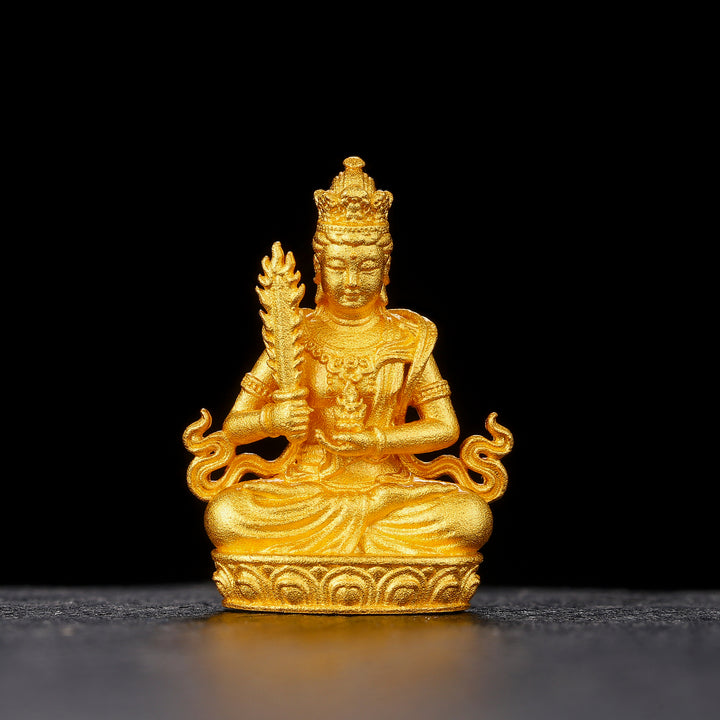
Those sources are a reason to use the name carefully, not to force the supplied pendant into an exact historical category. In this photograph, we can see a seated gold-tone figure within a halo-like arch, set inside an ornamental enclosure. We should not declare that its hand position exactly reproduces the Met sculpture's mudra, or that the pendant belongs to a particular school, date, or ritual practice. A good visual description holds both ideas at once: the supplied name gives the reader a term to research, while the visible design gives the reader a form to study.
A four-part way to read this pendant
- Threshold: begin with the outer silver-tone contour and green stone border. It marks the object as an enclosure.
- Focus: move to the clear-stone inner arch and the dark recessed field. They direct attention toward the center.
- Image: observe the seated gold-tone figure, halo-like surround, and layered base without adding unverified details.
- Axis: trace the lotus bail, figure, and lower loop in one vertical line to understand how the pendant hangs and balances.
This method is especially helpful in a jewelry photograph, where reflections and small details can make a pendant seem busier than it is. It also keeps historical comparison disciplined. A historical gau may have a window, contents, and a specific devotional use; this pendant visibly has a framed central image and a strong enclosure-like outline. The first is a documented category. The second is what the photograph shows.
Compare form without turning it into a product claim
For a wider view of wearable formats, browse Likreat's Necklace and Pendant collection. If you want to compare an enclosure with a pendant whose meaning comes more from its overall silhouette, the stupa-inspired pendant visual guide offers a useful contrast. In both cases, the aim is not to assign power to an object. It is to notice where the design places its center, edge, and point of suspension.
That is the most durable way to approach a Dainichi Nyorai ghau box pendant: look from frame to image, and let the visible layers do their work before making a historical or devotional claim. For related material, visit the Buddhist Tradition collection.
Sources
[1] Rubin Museum of Himalayan Art, “Amulet Box (Gau).”
[2] Project Himalayan Art, “Amulet Box (Gau) with Its Contents.”
[3] The Metropolitan Museum of Art, “Dainichi, the Cosmic Buddha (Mahavairocana).”