
A stupa-inspired pendant can look like a tiny temple at first glance. The useful question is not whether every curve carries one fixed meaning. It is how to notice the visual choices that make a small object recall a much larger Buddhist form. Start at the bottom, move upward, and keep the contemporary object separate from the historical architecture that informs the comparison.
Begin with the base
A base gives a form weight. The National Museum of Asian Art describes a stupa as a Buddhist reliquary, and its Sacred Spaces glossary notes that an early stupa was a hemispherical structure set on a platform. That is why a stepped, squared, or bowl-like lower section is often the first useful thing to notice. It establishes a grounded zone before the eye reaches the more decorative upper forms.
This is a looking tool, not a rule for naming an object. Stupas changed as Buddhism moved across regions, and their proportions, materials, and architectural vocabularies changed with them. A base in a pendant may simply borrow the visual logic of support; it does not establish that the pendant is a reliquary or a historical miniature.
Find the central volume
Next, locate the central mass. In many historical accounts, the stupa's rounded body is its most immediately recognizable feature. The National Museum of Asian Art notes that Tibetan-style examples can combine a bell-shaped body with a square base, while its broader explanation stresses that stupa forms expanded as Buddhism developed and spread. The key is proportion: does the design gather into one protected center, or does it open outward into a frame?
That distinction helps when a designer translates architecture into jewelry. A pendant may use an open surround to make the center visible, rather than copying a monument literally. Describe the construction you can see - a frame, a chamber, a raised figure, an opening - before attaching a regional label.
Read the upward movement
After base and body, look for an upward direction. A taper, flame-like border, finial-like point, or narrowing crown can make the eye travel from a broad foundation toward a smaller upper termination. That vertical sequence is one reason stupa-inspired designs can feel architectural even at pendant scale. It is a compositional observation, not evidence of ritual function.
Historic context remains important. Smarthistory describes the stupa as a major form in Buddhist art and architecture, while the National Museum of Asian Art's exhibition material discusses stupas as shrines that people may walk around in particular settings. Those practices belong to the sites and communities that give them meaning. A jewelry design can allude to a form without inheriting the role of a shrine.
Use negative space as evidence
Small-scale objects often replace masonry volume with openings. Negative space can isolate a central figure, lighten the silhouette, and make a frame read as an enclosure rather than a solid block. When you look at a stupa-inspired pendant, ask what the openings do: Do they create a chamber? Do they trace an outline? Do they separate a lower support from an upper flourish? These questions stay close to visible design rather than asking a product photograph to prove more than it can.
Reading the Sanctuary Stupa Pendant
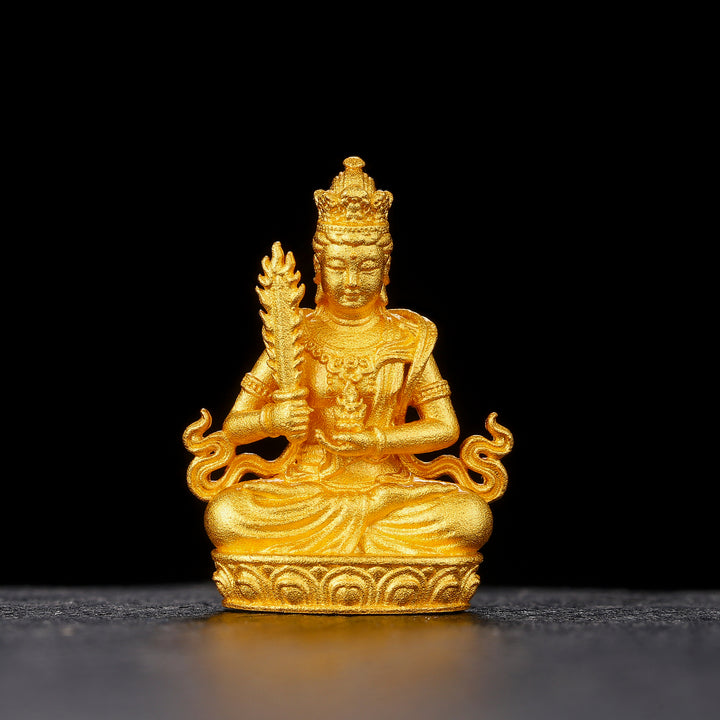
Likreat's Sanctuary Stupa Pendant offers a contemporary example of this sequence. In the main image, a gold-tone outer frame rises from a small lower base and encloses a clear seated figure. The surrounding openwork creates a distinct central chamber, while the upper border gives the silhouette a lifted, tapering direction. These are visible formal features. The image does not establish the pendant's material, ritual status, historic origin, or relationship to a particular stupa tradition.
Reading it from base to crown makes the structure easier to see: lower support, protected center, upward surround, then suspension from the bail. This method is especially useful when a product title supplies a broad reference but the design is contemporary. It lets a reader appreciate an allusion without turning it into a claim of equivalence.
Keep form, history, and belief distinct
Stupas can be monumental, handheld, architectural, or rendered in many regional styles. Their histories are connected to Buddhist communities and practices, not to a single universal decorative code. A careful product reading identifies the visible framework, cites the historical context, and leaves religious use and interpretation to practitioners and qualified teachers.
For related objects, browse Likreat's Buddhist Tradition collection. For another way to use close looking without overclaiming, see how to read a mandala design from center to edge.