
The quickest way to make sense of this dzi bead Garuda ring is to resist giving every element a single, sweeping meaning. The supplied piece has a strong visual hierarchy: a black-and-white eye-pattern bead at the center, an open silver-toned band, and small bird-like reliefs with gold-toned accents around the setting. Those observations are enough to begin. They do not, by themselves, establish the age, material, ritual use, or origin of the central bead.
Begin with the eye-pattern bead
The central oval is the visual anchor. Its high-contrast pale ring and dark center create an eye-like motif, while the surrounding dark field keeps the pattern legible at a small scale. In contemporary jewelry, this kind of motif is often described with the term dzi. That label should be handled carefully: a photograph cannot authenticate a bead, identify its material, or date it. The British Museum describes an excavated brown-and-white agate bead as allied in shape, form, and material to Tibetan dZi beads; that comparison is useful context, not evidence that this ring contains an antique or agate bead.
Read the bird relief as a design layer
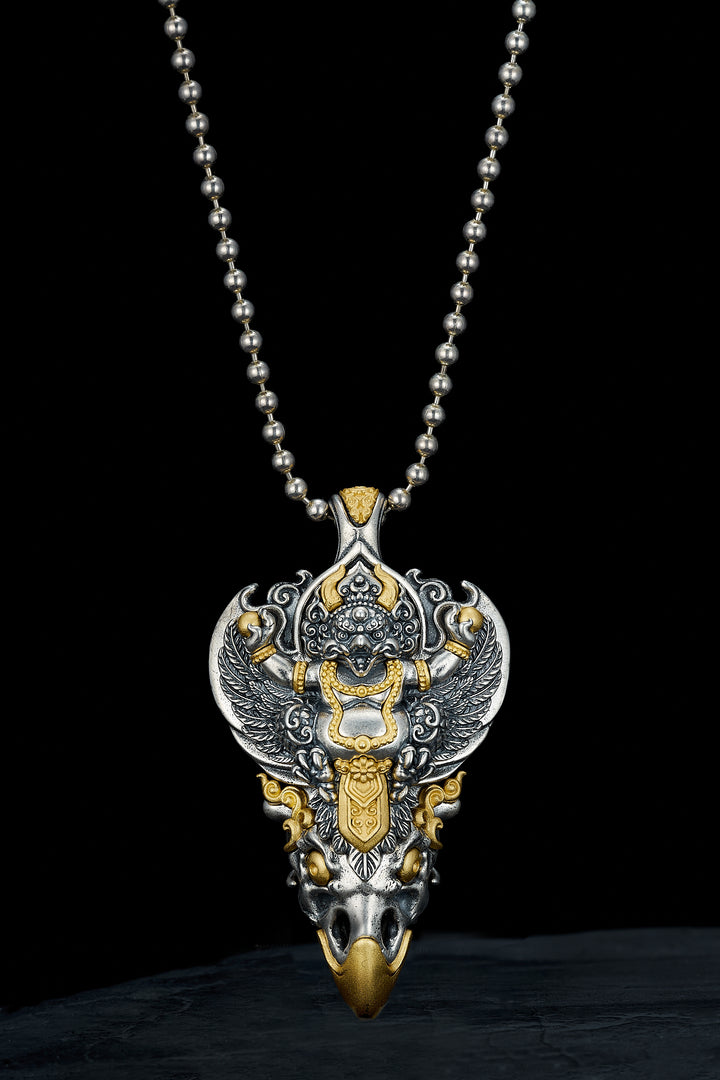
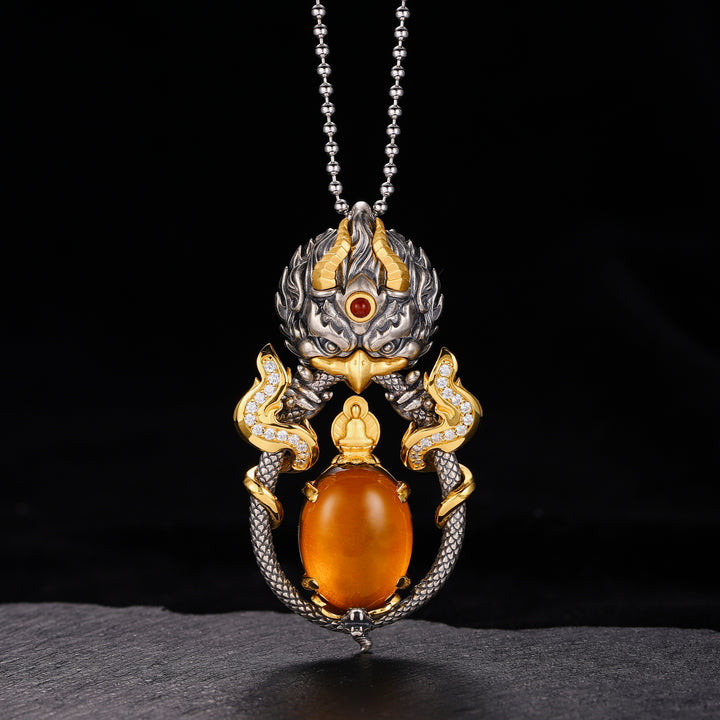
The ring's raised bird motif is supplied and named as Garuda. In historical art, Garuda appears in more than one regional language of form. The Metropolitan Museum of Art describes a Nepalese work of Vishnu riding on his half-bird, half-human mount, Garuda; the British Museum likewise identifies Garuda as Vishnu's bird vehicle. Those records help explain why wings, beaks, talons, and serpentine forms can be meaningful visual vocabulary. They do not make every contemporary bird relief identical in meaning or function.
For this ring, look at the relief before assigning a story to it. Notice how the bird forms frame the central oval rather than replace it. Their texture breaks up the smooth bezel, while the gold-toned details pull the eye back toward the bead. The result is less a miniature narrative scene than a compact composition built from contrast: pale and dark, polished and textured, central oval and branching relief.
Notice the opening in the ring band
The visible gap at the back is part of the ring’s construction. It shows that the band is open rather than a continuous circle, while keeping the sculptural bezel as the visual front. In this design, the opening gives the raised bird relief and central eye-pattern bead a clear, uninterrupted focal point.
A three-step method for looking closely
- Trace the silhouette. Start with the oval bezel, then follow the raised bird forms down to the open band. This separates the central bead from the mounting that surrounds it.
- Compare surface treatments. The smooth black-and-white eye pattern, bright metal edge, darker relief, and gold-toned accents create the design's rhythm. Describe those visible contrasts before naming a material.
- Keep historical context proportionate. Garuda and dZi-bead references can deepen visual understanding, but a modern ring should not be presented as a historical artifact, a ritual implement, or a promise of protection.
Why the distinction matters
Terms such as Garuda and dZi point to long and varied artistic and religious histories. They deserve more care than a quick list of benefits. The most useful reading of this contemporary ring is therefore specific: it combines an eye-pattern focal point with a Garuda-inspired sculptural frame and an open-band profile. That account honors what can be seen, gives the historical references their proper limits, and leaves authentication or material claims for evidence that a photograph does not provide.
Related reading
- Garuda in art: wings, serpents, and devotion
- How to read an auspicious Dharma eye ring
- Explore Likreat rings