
Samantabhadra in Art: How to Read the Crown, Lotus Sceptre, and Seat
Samantabhadra, often called Puxian in Chinese and Fugen in Japanese, appears in many Buddhist visual traditions. A figure may be richly crowned, shown with a lotus or sceptre, or paired with an elephant. The supplied image selects only some of those cues. Reading it well means noticing what is present without assuming that every familiar attribute must appear.
Begin with the crowned bodhisattva figure
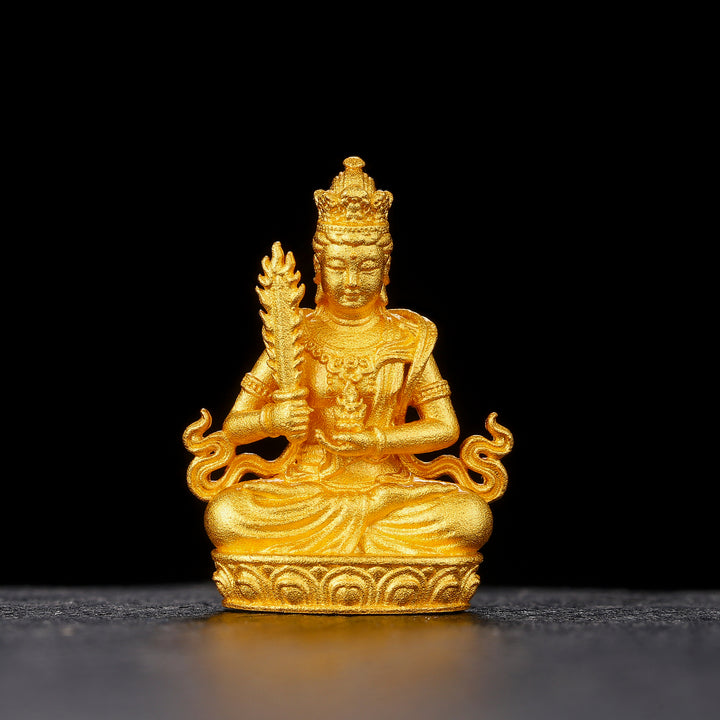
The figure in this image is seated cross-legged on a lotus base, wearing an elaborate crown and jewelry. Those details place it in a bodhisattva visual register rather than the robe-and-shaven-head type often used for a monk. The Metropolitan Museum of Art catalogues a Chinese sculpture as Bodhisattva Samantabhadra Puxian, a reminder that historical Samantabhadra images have appeared in very different materials and formats. The photograph alone does not establish this object’s maker, material, date, provenance, or ritual status.
The sceptre is a useful comparison point
A diagonal staff rises from the figure’s left hand to a lotus-like top. The British Museum’s record of a Ming wall painting describes Samantabhadra/Puxian as a crowned bodhisattva holding a sceptre. That makes the staff a useful iconographic comparison. It does not mean the supplied sceptre reproduces the museum painting exactly: its rounded lotus-like tip and compact handle are choices within this contemporary design.
The diagonal line also organizes the composition. It breaks the symmetry of the seated body, leads the eye from hand to shoulder, and gives the crown a visual counterweight. When reading small figures, these compositional roles can be as revealing as a named attribute.
Why the elephant is absent here
Samantabhadra is frequently associated with an elephant, especially the six-tusked white elephant in East Asian Buddhist art. The National Museum of Asian Art connects portrayals of Fugen on that elephant to the Lotus Sutra, and its Chinese collection includes a Samantabhadra-and-elephant sculpture record. This figure has no animal companion. That is not a contradiction; modern, compact compositions often retain a crown and sceptre while leaving out a large secondary form.
Absence can therefore be informative. It tells us that the design emphasizes the central bodhisattva silhouette—crown, face, hands, cloud-like scrolls, and seat—rather than a narrative mount.
Read the lotus base as a setting, not a sole identifier
The two-tier lotus base gives the seated body a broad finish. Repeated petals echo the rounded crown and the curved forms extending beside the knees. Lotus bases are widespread in Buddhist art, so they should not be used alone to name a figure. Here they work alongside the crowned appearance and sceptre to make the Samantabhadra comparison more legible.
For another example of how an attribute-led reading works, see Likreat’s guide to Manjushri’s sword, book, and lotus. Each figure needs its own evidence rather than a generic list of symbols.
A four-step method for similar figures
- Identify the figure type. Crown, ornaments, and seated pose indicate a bodhisattva presentation.
- Follow the held object. A sceptre or lotus-topped staff can be a stronger cue than surface decoration.
- Check for the elephant—but do not require it. It is an important association, not an every-image rule.
- Keep visual observation separate from product claims. Describe the gold-toned finish and carved details, but do not infer material or age from a photograph.
A compact figure with a selective visual vocabulary
This small design presents Samantabhadra through a focused set of cues: a composed crowned figure, a lotus-like sceptre, cloud scrolls, and a carefully layered lotus seat. It leaves out the elephant and does not attempt to recreate a single historical work. That selectivity is precisely what makes the figure readable at a small scale.
Explore related works in Likreat’s Buddhist Tradition collection and the Sacred Jewelry Journal.