
Why does a Tsongkhapa image sometimes carry the same sword-and-book vocabulary readers associate with Manjushri? The answer is not a shortcut from one object to one name. In museum records, Tsongkhapa appears as a historical teacher in monastic robes, with hands meeting at the heart, while lotus stems rise beside him to support a sword and a book. The shared attributes are meaningful, but their placement and the figure's presentation matter.
This guide offers a way to look at Likreat's Tsongkhapa Lotus Throne Sculpture without treating a contemporary object as a historical artifact. It does not promise wisdom, protection, authenticity, or ritual effect. Instead, it separates what the image visibly shows from what particular museum records document.
First, recognize that this is a teacher image
Tsongkhapa (1357–1419) is named in museum records as a Tibetan Buddhist teacher and high lama. An Asian Art Museum label describes him seated on a lotus pedestal in a monk's robe and yellow hat; it also identifies the surrounding scenes in its painting as episodes of teaching and study. [1] That context changes the question. The image is not identified only by an implement. It is also an image of a teacher, represented through clothing, gesture, and the organization of the whole figure.
The Rubin Museum's sixteenth-century sculpture gives a similar starting point. Its description names monastic robes, hands held at the heart, and a sword and book resting on lotuses above the shoulders. [2] These details work together. A sword or manuscript on its own is not enough to make a confident identification from a photograph.
Read the hands before the objects above them
In two Rubin records, Tsongkhapa's hands form the shape of a wheel, which the museum identifies as a teaching gesture—an allusion to turning the wheel of dharma. [2] [3] The National Palace Museum in Taipei likewise describes its 1781 Tsongkhapa statue with the hands joined at the chest in a teaching gesture. [4]
For close looking, notice where the hands meet. A compact, centered gesture creates a stable visual core. The stems and objects above the shoulders then read as a second register, rather than as hand-held accessories. This order—hands first, shoulder lotuses second—helps prevent a quick identification based only on a familiar sword.
Then follow the lotus stems to the sword and book
In the Smithsonian's 1834 Lotus Lama thangka, two lotus flowers rise over Tsongkhapa's shoulders. A flaming sword stands on one flower, while a red-covered book rests on the other. [5] The Asian Art Museum uses the same spatial relationship in its label: the sword and the Perfection of Wisdom book rest on lotuses held in Tsongkhapa's hands. [1]
That placement is the useful clue. The sword and book are elevated beside the teacher rather than simply gripped in projecting hands. A contemporary sculpture may simplify the stems or make their tips difficult to see, so it is better to describe the visible route—hand, stem, bloom, object—than to assign an unseen detail.
Why the comparison with Manjushri matters
Manjushri is a distinct bodhisattva of wisdom. The Metropolitan Museum of Art's Tibetan sculpture identifies the palm-leaf manuscript on a lotus bloom as a principal marker and names the sword as Manjushri's other attribute. [6] That is why the two figures can look related at a glance.
But related attributes are not identical identities. The Asian Art Museum's Tsongkhapa label explicitly links the teacher's sword and book to Manjushri while also describing his monk's robe and yellow hat. [1] The comparison works best as a pair of observations: look for a teacher's dress and heart-level teaching gesture; then see whether the sword and book are borne on the two rising lotuses. For a deeper look at the bodhisattva's own iconography, see our Manjushri sword, book, and lotus guide.
A four-zone reading of the Likreat sculpture
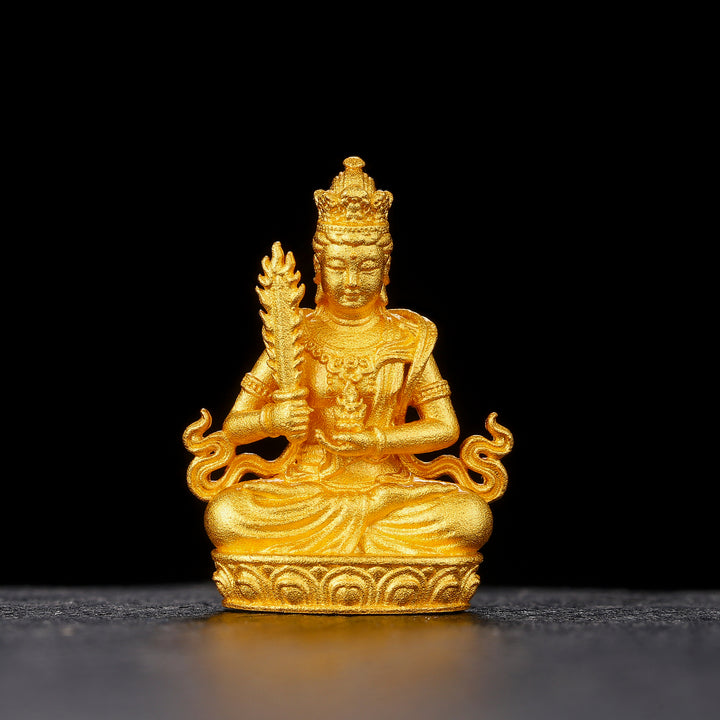
Likreat's product is titled Tsongkhapa Lotus Throne Sculpture. In the user-supplied image, the figure can be read in four zones.
- Head and halo: a tall yellow-hat-like crown sits within a circular halo.
- Hands: the hands meet at the chest in a compact central gesture.
- Shoulders: two stems rise to either side, creating the space where a source-led viewer would look for lotus-borne attributes.
- Support: red robes lead down to a layered lotus throne and a separate, ornate base.
These are observations about the supplied contemporary product image. The product page describes a lotus throne, circular halo, red robes, shoulder stems, and central teaching gesture. It does not establish that this sculpture has the material, age, provenance, consecration, or exact iconographic detail of the Tibetan, Qing, or nineteenth-century museum works cited above.
Keep the sources and the product in their proper places
The museum records make the visual vocabulary more legible; they do not turn a current product into a substitute for their collection objects. The most respectful reading leaves room for both: one can appreciate the reference to a teacher image while being precise about what the product photograph confirms.
Readers who want more brand context can visit Likreat's Je Tsongkhapa reference page or browse the Buddhist Tradition collection. The same method still applies: identify the figure through several visible relationships, check a named source, and do not ask a commercial object's appearance to prove more than it can.
Sources
[1] Asian Art Museum, The lama Tsongkhapa.
[2] Rubin Museum of Himalayan Art, Tsongkhapa (1357–1419), 16th century.
[3] Rubin Museum of Himalayan Art, Tsongkhapa (1357–1419), 19th century.
[4] National Palace Museum, Taipei, Gold statue of Tsongkhapa.
[5] Smithsonian National Museum of Asian Art, Lotus Lama.
[6] The Metropolitan Museum of Art, Manjushri, the Bodhisattva of Transcendent Wisdom.