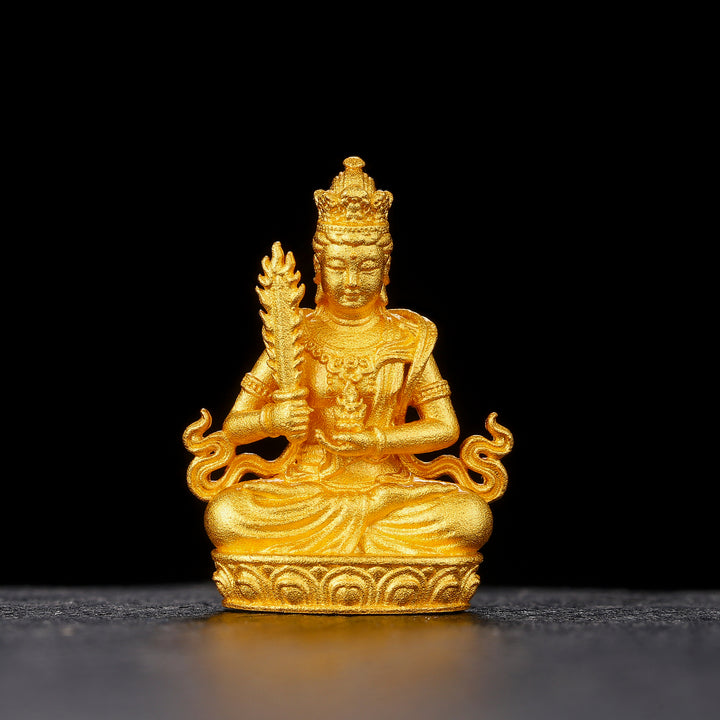

A Vajrasattva figure can be compact yet still make its visual priorities clear. The hands and their implements offer a more useful starting point than a generic label or an assumed ritual claim.
Look for the pair before naming the figure
In Buddhist visual culture, an attribute can be more informative than a generic seated silhouette. The supplied image is identified as Vajrasattva. Its compact format encourages a close look at the hands and the implements they hold, rather than an assumption based only on the crown or lotus base. If an object is too small or a detail too soft to read, it is better to say so than invent an identification.
The vajra and bell create a visual conversation
A Metropolitan Museum of Art record for an eighth-century Vajrasattva from Kashmir describes the deity holding a stylized thunderbolt and a bell. That pair is a useful starting point for reading Vajrasattva images. It does not mean that every modern figure copies the same pose or that every small hand-held form is legible from a photograph. It does show why the two implements deserve attention when they are visible.
Why this pair became central to the figure's story
Vajrasattva's name is commonly translated as “vajra being” or “thunderbolt being.” Museum records show that the identity has travelled across a wide artistic geography: an eighth-century Kashmiri image in The Met holds vajra and bell, while a thirteenth-century Tibetan work in the Rubin Museum is identified through the traces of those same attributes. The recurrence does not turn every crowned figure into Vajrasattva; it shows why artists and viewers return to the hands when the name is given.
The pair also carries a disciplined visual logic. The Rubin Museum explains the vajra as method or compassionate action and the bell as wisdom; together they represent their union in Tantric Buddhist contexts. That is cultural background for understanding historical iconography, not a claim that a contemporary small figure performs a ritual function or delivers an effect to its owner.
Scale changes what an artist can show
Large sculptures can make the vajra, bell, jewelry, lotus, and surrounding forms distinct. A small tabletop figure has to compress that vocabulary. The result may simplify fingers, ornament, or the exact contour of an implement. This is a design reality, not a defect, and it is one reason to avoid treating a compact decorative object as a precise reconstruction of a particular historical work.
Read the centerline
A practical method is to start at the crown and face, move down the torso, then follow the arms to the hands. Notice whether the artist has organized the figure around a centered axis or an asymmetrical gesture. The vajra itself is often designed around a central line and balanced ends, so it can make a useful comparison point even outside a strictly religious context.
A bounded interpretation
This figure can be appreciated as a contemporary visual reference to Vajrasattva without claims about blessing, consecration, healing, or spiritual effect. The strongest reading is the observable one: a small golden seated image that condenses a much wider artistic vocabulary into a limited space.