
Akashagarbha Pendant: How to Read a Small Bodhisattva Figure
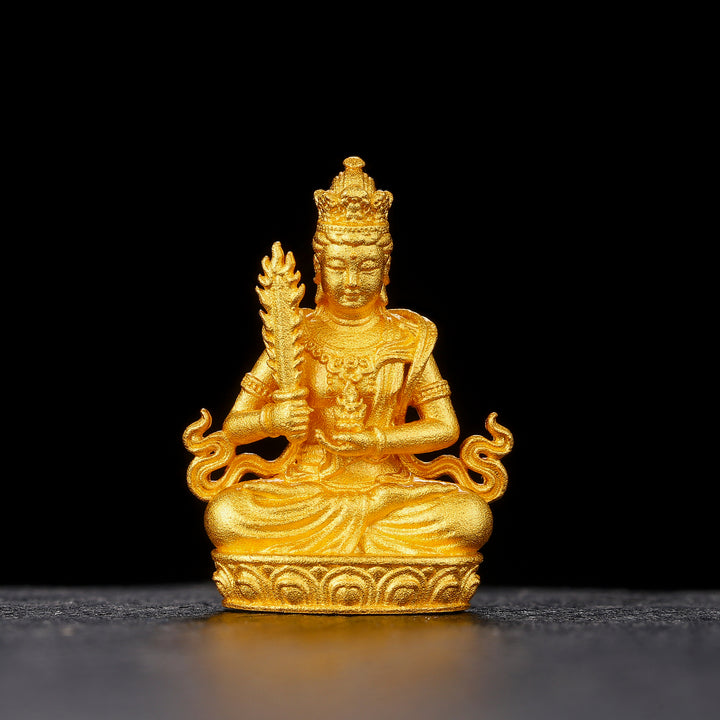
A small pendant can hold many visual clues, but it rarely gives up its identity through one clue alone. This gold figure is presented as Akashagarbha—also called Kokuzo in Japan and Xukongzang in Chinese contexts. The most useful way to look at it is not to start with a promise or a fixed meaning. Start with what is actually there: a crowned seated figure, a flame-shaped surround, a long upright implement, a compact form held near the chest, and a lotus base.
That approach matters because Akashagarbha imagery is not a single, unchanging template. The Tokyo National Museum's Kokuzo painting explicitly notes that the deity's iconography changes according to ritual use. Before naming any detail in a modern pendant with certainty, compare the whole arrangement.
Begin with the seated figure and lotus base
The figure sits cross-legged on a two-tier lotus base. In Buddhist art, the lotus is a recurring seat and should be read first as a compositional foundation: it separates the central figure from the ground and gives the small object a stable visual centre. It is not, by itself, an identification tag. The Tokyo museum's 12th-century Kokuzo image likewise places the bodhisattva on a lotus dais, while its wider record cautions that forms differ by practice and setting.
For a useful comparison of method—not an identification shortcut—see Likreat's guide to how to read a pendant figure. Look at posture, base, surround, and hand-held elements as one visual sentence.
Read the crown and flame-shaped surround as framing devices
The pendant gives the figure a detailed crown and a radiating, flame-like surround. These features direct the eye toward the head and make the tiny seated form legible at necklace scale. Museum records show a crowned Kokuzo in more than one setting: the Nara National Museum example describes a golden, crowned figure seated in lotus position, while its precise hand and light motifs differ from this pendant.
That difference is the point. A halo, crown, or flame border can establish emphasis and sacred presence in an image, but it does not prove a universal formula. The British Museum's Dunhuang painting is only tentatively identified as Akashagarbha, even though it supplies other unusual emblems. Good looking means allowing that uncertainty to remain visible.
Do not name the upright implement too quickly
At the figure's left is a tall, leaf-like upright form. From this photograph alone, it is safer to describe it than to force a label. A Seattle Art Museum portable shrine identifies Kokuzo's attributes as a sacred jewel and a sword, seated on a lotus throne. That makes a sword comparison reasonable, but it does not demonstrate that every long object in every later image is the same attribute.
This restraint is especially helpful when comparing neighboring bodhisattva images. In Manjushri's sword and book, the paired attributes form a different visual combination. Ask what the object is paired with, where it is held, and how it relates to the figure's posture before deciding what you are seeing.
Notice the small form held at the centre
The other hand gathers a small raised form close to the chest. It may recall the jewel-bearing imagery found in some Kokuzo records, but the supplied image is too small to identify it as a particular jewel, scripture, or ritual object. This is a productive place to pause rather than overread. On the Tokyo museum painting, a jewel is specifically documented; on the Nara painting, flaming sacred jewels sit on a lotus stem. Those records give vocabulary for comparison, not a license to assign undocumented specifications to this pendant.
A five-point checklist for this pendant
- Locate the seated figure and lotus base before isolating an attribute.
- Read crown and flame-shaped surround as visual framing, not proof of one tradition.
- Describe the upright implement first; compare it with documented sword forms second.
- Keep the central hand-held form open to inspection unless a reliable record confirms it.
- Compare whole arrangements across collections and regions.
For another way to practise this slow, whole-image reading, explore the guide to crown, lotus, and sceptre. The value is not in reducing a living visual tradition to a checklist; it is in learning to see closely, distinguish evidence from assumption, and let the particular object lead.
Sources
- Tokyo National Museum / e-Museum: Kokuzo Bosatsu (Akashagarbha)
- Nara National Museum / e-Museum: Kokuzo (Akashagarbha)
- Seattle Art Museum: Portable shrine with Bodhisattva Kokuzo
- The Metropolitan Museum of Art: Initiation Card (Tsakalis): Akashagarbha
- British Museum: Akashagarbha painting from Dunhuang